Embroidery stitches / French knot
French knot
A French knot is a small raised dot made by wrapping thread around the needle. Bring the needle up, wrap the thread around it twice, and put the point back down right next to where it came up, not in the same hole. Hold the thread taut while you pull the needle through, and the wraps tighten into a knot.
- Beginner
- Detached stitch
- knots 4 mm apart
Free practice sheet
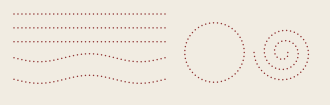
Straight lines, curves, a circle and a spiral, with a dot for every knot
Print at "Actual size" (100%), then check that the scale bar measures 5 cm, so the marks are true to size. Trace the dots onto fabric and make one knot on each dot.
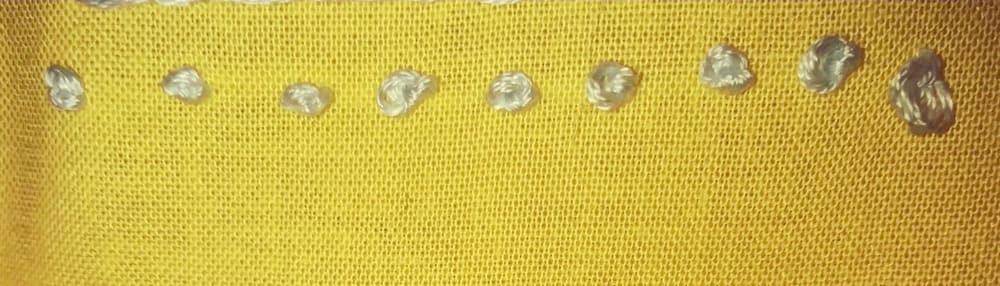
In real thread
Before you start
- Needle: an embroidery (crewel) needle, size 7 to 9 for two or three strands. Its long eye takes floss easily.
- Strands: six-strand floss comes as six thin threads twisted together. Cut about 45 cm (18 in), pull out the strands you need one at a time, then lay them back together.
- Starting: for the first thread, tie a small knot at the end and come up from the back. For line stitches, a waste knot is neater: knot the end, go down on the front about 5 cm (2 in) away along your line, stitch toward it so your stitches cover the tail on the back, then cut the knot off.
- Finishing: on the back, slide the needle under three or four stitches, then trim. Once there are stitches on the back, start each new thread by sliding it under them too, without a knot.
Step by step
-
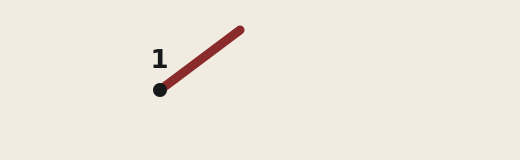
Bring the needle up at 1, where the knot should sit. Hold the thread taut with your other hand.
-
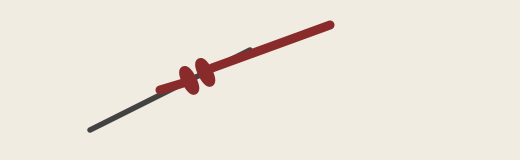
Hold the thread taut with your non-stitching hand, a few centimetres from the fabric. Hold the needle close to the fabric, lay it against the thread and wind the thread around it twice.
-

Put the needle point down at 2, right next to 1 but not in the same hole. Slide the wraps down to the fabric and push the needle through while you keep holding the thread.
-
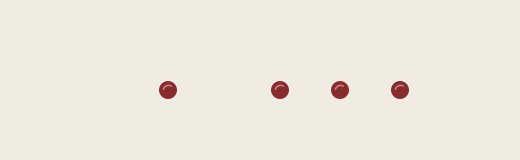
Pull through gently: the wraps tighten into a knot on the surface.
Filled dot: the needle comes up. Ring: the needle goes down.
Front and back
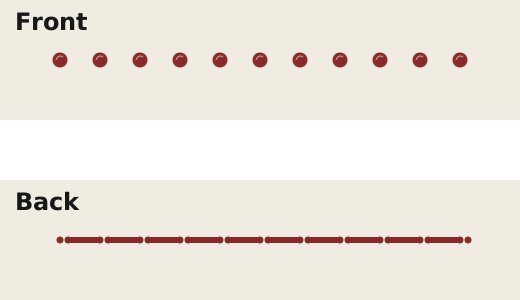
Each knot leaves only two holes close together on the back. Between knots the floss travels across the back: keep those jumps short, or end off and start again, so they do not show through light fabric.
The back is drawn as if seen through the cloth, so its holes line up with the front.
Tips
- Two wraps make a neat knot; three at most. For a bigger knot, use more strands instead of more wraps.
- Keep the thread taut until the needle is all the way through. That is what stops the knot from going loose.
- Go down a thread or two away from where you came up. In the same hole, the knot pulls through to the back.
- Work in a hoop so both hands are free: one for the needle, one for the thread.
Common mistakes
- Knots that vanish to the back: the needle went down in the same hole as it came up.
- Loose, loopy knots: the thread went slack while pulling through.
- Uneven knots: different numbers of wraps or strands. Keep both the same across a piece.
Patterns to use it on
- Embroidery letters
- Every dot on an i or j and every full stop in the name templates is a French knot.
- Lazy daisy stitch
- A French knot is the usual centre of a daisy.
Questions
- How many times do you wrap a French knot?
- Twice is usual, three times at most. More wraps make a knot that topples over; use more strands for a bigger knot.
- Why do my French knots pull through?
- The needle went back down in the same hole. Move it a thread or two away.
- What is the difference between a French knot and a colonial knot?
- Both are wrapped around the needle. For a colonial knot the thread goes around it in a figure of eight instead of being wound, which makes a slightly taller, firmer knot.
More stitches


Sources
Updated