Sashiko patterns / Yamagata (Mountains)
Yamagata (mountain) sashiko pattern
Yamagata is rows of zigzag lines that look like a range of mountains. It is the simplest sashiko pattern to stitch: every line is straight and no lines cross. Print the template at 100%, trace the rows, and stitch each zigzag from left to right, leaving a small gap at every peak and valley.
- Beginner
- Panel 18 × 18 cm
- Stitches 3 mm, gaps 1.5 mm
Download the free template
Every size fills the same 18 cm square; the number is the zigzag pitch. Smaller is denser and takes longer.
- 10 mmFine ~972 stitches · ~8 m thread · 1.5–3 h US Letter A4
- 15 mmClassic Recommended · ~864 stitches · ~5 m thread · 1.5–3 h US Letter A4
- 20 mmBold ~756 stitches · ~4 m thread · 1.5–2.5 h US Letter A4
Print at "Actual size" (100%), never "Fit to page", then check that the scale bar on the sheet measures 5 cm. Stitch and thread counts are estimates for the whole 18 cm panel (thread includes the back of the work and 15% for knots). Hours assume 5 to 10 stitches a minute. Page 2 of each PDF has the stitching order.
What you need
- Fabric: a 25 cm (10 in) square of medium-weight cotton or linen with a soft, even weave. That is the 18 cm panel plus room to hold it.
- Thread: about 5 m of sashiko thread at the recommended size, used as a single strand (check the length on your skein). Perle cotton no. 8 works too.
- Needle: a sashiko needle (long, with a large eye), or a long darning needle.
- Marker: a water-soluble fabric pen or a chalk pencil for tracing. Test it on a scrap first.
- Optional: a thimble. Sashiko is usually stitched in the hand, without a hoop, so the needle can take several stitches at once.
Time: about 1.5 to 3 hours for the whole panel at 15 mm, our estimate at 5 to 10 stitches a minute. A smaller piece takes less.
How to stitch it
New to sashiko? The running stitch guide shows how to load several stitches on the needle, the way sashiko is sewn, and how to start and finish a thread. Leave a little slack where the thread turns at the end of a row, so the fabric does not pucker.
- Trace the template onto your fabric with a light box or a sunny window and a fabric marker. On dark fabric such as indigo the lines won't show through: use white dressmaker's carbon paper instead.
-
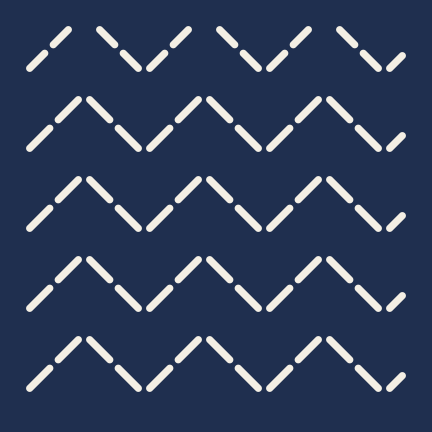
Stitch each zigzag row from left to right, top row first.
- Keep every crossing point open: stop short of the point where lines meet, as the template shows, and start again just past it.
Bright: the stitches for this step. Faded: stitches already done. Dashed: lines still to stitch.
About this pattern
Leaving a gap at each turn keeps the points sharp. If you stitch straight through a peak, the zigzag turns into a soft wave.
Yamagata is a good warm-up before asanoha: it trains even stitch length on straight diagonals.
Questions
- What is the easiest sashiko pattern?
- Yamagata and hitomezashi are the easiest: straight lines only, and yamagata has no crossings at all.
- Can I change the spacing between rows?
- Pick a different size: the row spacing grows with the zigzag pitch (10, 15 or 20 mm).
More sashiko patterns
Sources
Updated